Biggest breakthrough at Santorini

Tagged:
Santorinia donkey taxi

This month we carried out the first ever official health checks of the donkey taxis working on the Greek island of Santorini. Here, they carry tourists from the ferry port up 680 steps to the town of Fira each day and endure harsh working conditions, and often carry people weighing almost their own body weight.

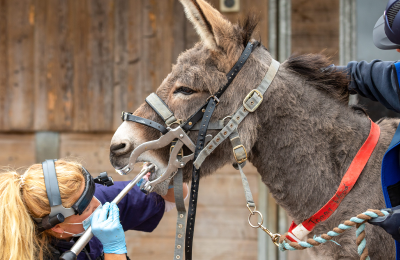
On 23-24 May 2009, Paul Svendsen, our director of European operations, and a team including a vet, dentist, farrier and welfare officers provided health checks to 120 donkeys and mules. This is part of a new scheme we have introduced in co-operation with the Municipality of Fira, to ensure only donkeys considered fit enough can work.

Initially, the donkey owners were reluctant to bring their donkeys to our team or take off their donkeys packs, but they soon realised that we were there to help. We issued new harnessing to make life more comfortable for the donkeys and those who didn't pass the health check won't be allowed to work under the new scheme until the owners can prove their animal is fit to work once again.

So many other great things came out of the weekend. The President of Donkey Owners has agreed to ensure the donkeys receive water and shelter when they are not working and improve the system of loading/unloading passengers.

In the future, we will carry out these official health checks with the Municipality twice yearly and Konstantinos Tsikrikas, who runs our Greek Holding Base in Trikkala, has been appointed as our dedicated Welfare Officer for Santorini, and will be visiting on a monthly basis to provide advice and support to the taxi operators and monitor the well being of the donkeys.

We are also going to train six of the younger donkey owners in basic farriery and dentistry as there are currently no experts on the island.

Dear Paul,

You and I have corresponded briefly about the donkeys of Santorini. I'm a long-time TDS admirer and especially love your work in Spain, Italy, Cyprus and Greece.

As an advocate for the animals of Greece, I am overjoyed at this news. As a donkey person myself, I am particularly relieved and happy. I knew that this operation was in the works and am thrilled to see that it has begun with such success.

I hope to post a link to this update on my website (see link below signature)

Bravo, Paul and team, and also kudos to the Greek animal people on Santorini who have worked with Paul to carry this off--to SAWA and Eleni especially!

Pamela Benbow
Editor, Greece & Cyprus Community
Best Friends Network

My family and I have just returned from a holiday in Santorini. While visiting Fira we stopped to read the information about the donkeys and view their living conditions and work. These poor donkeys do indeed work very hard carrying tourists up the very many steps from Fira old port to the town at the top. Many visitors take one of the cable car rides down and a donkey back up for the experience. One of the donkey owners told us that new accommodation and shelters were being built for the donkeys. There are very many donkeys in Santorini, some looking the worse for wear living and working in the heat with very little shade or access to water. Tourists as well as locals need educating about these beautiful animals. I hope the appointment of Mr Tsikrikas will make a much needed difference.

I came across your site by chance and now cannot exit it without comment. I have resently returned from the island of Rhodes . While there in Lardos I witnessed tethered donkeys being left without shelter or water for whole days as a time. One donkey had a lower front leg amputated and I was informed that this was due to it's tether tightening around it. These are part of the team used to carry people up the Acropolis in Lindos. Earlier this year while there I witnessed goats being treated in the same manner in the same place - I have been told they died of starvation although I have no actual evidence of this. I saw many very sad animals while I was there.

Dear Mary
We do fund a team to go to Rhodes every year, next year we are planning to treat 130 working animals there. I will forward your info to the team so that they can report back. Unfortunatly there are many problems in Greece, if it were just a case of resourcing and training it would be achievable but the culture towards animal welfare is not good and this makes improving animal welfare standards very difficult.

Like Mary I have also been to the island of Rhodes recently.
There were 4 donkeys nearby to our apartment, that were working all day in the boiling heat, then tied up to rocks in the evening with no food or water.
I ended up taking apples and carrots to feed them every night, but as I was only there for a week I worry what may have happened to them afterwards. they were clearly very hungry and didn't look in good shape.
I would love to know if The Donkey sanctuary have done, or are planning to do any work with the Rhodes Donkeys.
Fantastic work in Santorini by the way!!!!

I have just returned from a holiday in Lindos, Rhodes and the whole experience was ruined by the total lack of compassion that most Greeks seem to have for animals there, in particular the poor donkeys.
At the house next door to my hotel, kept on waste-like ground, was a poor young donkey who didn't appear to be a working animal as he was tied up permanently for my entire week there, without shelter from the extreme heat, and it appeared, without water or food. Myself and a few other guests at the hotel took food and water to the poor animal on a daily basis but we are concerned as to what his fate is going to be when the holiday season is over. The Greeks don't seem to care.
I mentioned to the so-called holiday rep at the hotel that a number of her guests were distressed at having to witness this poor animal whenever we were leaving the hotel and she couldn't have cared less. She'd obviously been in Greece too long!
Can you advise as to what, if anything, British citizens can do to try and help end the suffering of those poor animals?

Dear Craig

Thanks for your email regarding the donkey in Lindos, Unfortunately you are correct when you say that animal welfare is not high on the list of priorities in Greece. In this case however we can do something but we will need a little more information from you regarding the location of the donkey.

Could you let me know the name and address of the hotel you stayed in please and I will organise for someone to go and check on it as soon as possible. Although it might appear the animal is not being fed or watered this is usually done very early in the morning and later at night when it is cool, it would be very rare even in Greece for an animal to be abandoned in such a way.

As soon as we have heard back from you regarding the location and we have had chance to check we will get back to you.

Regards
Paul Svendsen
Director of European Operations

We have been going to lindos every year for 10 years now and every year the donkeys upset me. I was although pleased to see that the sharpened sticks they used to use to jab the donkeys in the side aren't being used any more, is this the donkey sanctuarys influence? If it is, well done! This year, the saddles and bridles seemed better fitting too although I did see one donkey at the end of his shift with open sores on his back end from the saddle strap. I also saw a woman on a donkey who must have weighed twice or three times more than the poor donkey she was nearly flattening. I'm afraid I gave her a piece of my mind and told her she should be ashamed of herself. There really needs to be a weight limit surely!?
I also saw a donkey tethered at the very top of lindos near the lindos view hotel, he was out in the blazing heat all day with no shelter whatsoever,I couldn't see any water either. There are some donkey owners who look after their donkeys wonderfully I just wish they all were :•(
keep up the good work though donkey sanctuary!